

| You are here: what we do > issues we work on > control arms > understanding the issues |
![]() |
|
Arms kill more than half a million men, women, and children on average each year. Thousands more are maimed, or tortured, or forced to flee their homes. |
Arms kill more than half a million men, women, and children on average each year. Many thousands more are maimed, or tortured, or forced to flee their homes.
There are no comprehensive, legally binding rules to control the international arms trade. As a result arms often end up in conflict zones where they’re used to perpetrate human rights abuses.
Armed violence – whether in the form of armed conflict, gang warfare, or domestic abuse – seriously limits people’s ability to earn a living, grow crops, or benefit from education. Years of development are undone by war and conflict.
Billions of dollars that could be spent on development, health and education are instead poured into arms. For every dollar spent on development, ten dollars are spent on military budgets.
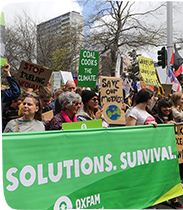
Oxfam, Amnesty International and the International Action Network on Small Arms (IANSA) established the Control Arms campaign in 2003 to demand governments toughen up controls on the arms trade and introduce an international Arms Trade Treaty to stop arms being sold to those likely to misuse them.
The campaign has gathered the support of over one million people around the world. In June 2006, the “Million Faces” petition was presented to Kofi Annan.
In December 2006, three years of tireless work involving more than one million campaigners came to fruition, when 153 governments voted at the UN General Assembly to start work on an Arms Trade Treaty to limit the flow of arms into conflict zones, and the hands of oppressive regimes.
In October 2009, most of the world’s governments agreed a timetable to establish a Treaty with the “highest possible common international standards” to control international transfers of conventional arms.
In July 2010, negotiations began on the terms of the Arms Trade Treaty, leading up to a conference in 2012. We hope member states will develop, sign and ratify an International ATT at this conference in 2012.
Oxfam attended the UN conference in July 2010 to encourage the nations of the world to establish a treaty that holds governments to account, and is workable, enforceable and strong enough to save lives.
![]() |
|
![]() |
|
![]() |
|
|
Oxfam Trailwalker Challenge yourself, challenge poverty! |
![]() |
Follow
|
|